
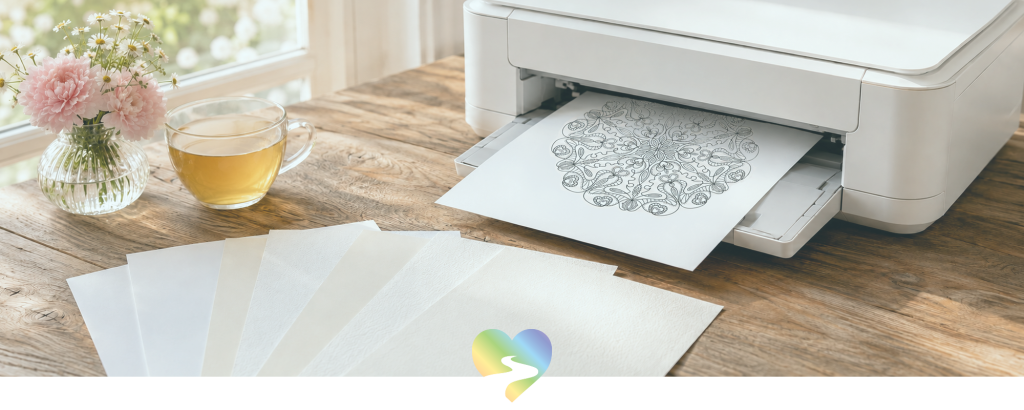
Choosing Your Paper for Mandala Coloring
You have found a mandala that speaks to you. Perhaps it is the symmetry, the delicate details or simply the feeling it gives you. You imagine yourself sitting somewhere peaceful, slowly bringing the pattern to life with colors of your own choosing.
Before that quiet moment can begin, there is one small decision to make: which paper will you print your mandala on?
Paper may seem like a simple background, but it influences how your colors look, how your materials behave and how enjoyable the coloring experience feels. The good news is that you do not need the “perfect” paper. You only need one that suits your printer, your chosen coloring materials and the way you enjoy creating.
Let’s find the paper that feels right for you.
Begin With Your Printer
Not every home printer can handle thick paper, so always check the recommended paper weight for your printer before buying anything new. You can usually find this information in the printer manual or on the manufacturer’s website.
Paper weight is measured in gsm, which means grams per square metre. A higher number usually indicates thicker and sturdier paper.
Many home printers comfortably accept paper between 80 and 160 gsm. Some printers—particularly those with a rear paper feed—can handle paper of 200 gsm or more.
If your paper is too thick, do not try to force it through the printer. Your mandala can wait patiently while you find a gentler solution.
Standard Printer Paper: 80–100 gsm
Ordinary printer paper is an accessible and affordable place to begin. You probably already have some at home, which makes it perfect for experimenting with colors or printing a mandala you would like to practice on.
It is most suitable for:
- Colored pencils
- Gel pens used lightly
- Fineliners used without repeated layering
Because standard paper is relatively thin, markers may bleed through it and wet materials can cause it to wrinkle. Place another sheet underneath when using pens, just in case.
Standard printer paper is not luxurious, but it carries an important message: you do not need special supplies before you are allowed to create.
Smooth, Heavier Paper: 120–160 gsm
For many people, smooth paper between 120 and 160 gsm offers the most versatile choice for printable mandalas. It feels more substantial than ordinary printer paper while remaining suitable for many home printers.
It works beautifully with:
- Colored pencils
- Fineliners
- Gel pens
- Light use of water-based markers
A smooth surface helps pencils and pens move easily across the page. It is especially helpful for mandalas with small details, where a rough texture may make precise coloring more difficult.
If you are looking for one dependable paper for regular mandala coloring, this is a lovely place to start.
Thick Paper: 160–200 gsm
Thicker paper creates a firmer surface and can usually hold more ink than standard paper. It is a good option when you enjoy stronger colors or want your finished mandala to feel sturdy enough to display.
It can be suitable for:
- Colored pencils with multiple layers
- Fineliners and gel pens
- Water-based markers
- Watercolor pencils used with very little water
Before purchasing this paper, check whether your printer can accept its weight. If possible, use the manual or rear feed, as this usually allows the paper to follow a straighter path through the printer.
Even on thicker paper, markers may still show through. A protective sheet underneath your work is always a wise little companion.
Printable Watercolor Paper: 200 gsm and Heavier
If you would like to use watercolor pencils or a small amount of watercolor paint, look for watercolor paper specifically described as suitable for inkjet or laser printers.
Traditional watercolor paper can be heavily textured and too thick for a home printer. Printable watercolor paper is usually thinner and has a surface designed to pass through a printer more easily.
It works well with:
- Watercolor pencils
- Light watercolor washes
- Water-based brush pens
- Mixed pencil and watercolor techniques
Use water sparingly. A very wet brush can cause the paper to buckle and may make inkjet lines run. If you plan to add water, print a small test image first and allow the printer ink to dry completely.
What About Marker Paper?
Marker paper is smooth and designed to help markers blend more evenly. However, some marker papers are very thin, and not every type is intended for printing.
When using alcohol markers, look for printer-compatible marker paper and remember that the ink will often bleed through, even when the paper is specially made for markers. Always place a protective sheet beneath your mandala.
You could also print your mandala on suitable paper and make a copy of the design before coloring. That way, you can explore different palettes without worrying about having only one chance.
Smooth or Textured Paper?
The texture of paper affects the appearance of your colors.
Smooth paper is ideal for detailed mandalas, clean lines and even areas of color. It works especially well with fineliners, gel pens and markers.
Lightly textured paper gives colored pencils and watercolor pencils a softer, more organic appearance. The texture may remain visible through the color, adding character to the finished mandala.
Very rough paper is usually less suitable for intricate designs because small spaces can become more difficult to color evenly.
Neither surface is better. One offers precision; the other offers softness. Your hands may prefer one before your mind has even decided.
White, Cream or Colored Paper?
Bright white paper makes colors appear clear, fresh and vibrant. It is the easiest and most versatile choice for most printable mandalas.
Cream or ivory paper creates a softer, warmer atmosphere. It can be beautiful with earthy shades, muted colors and metallic gel pens. Keep in mind that the paper color will gently influence every color placed upon it.
Pastel or lightly colored paper can create an unusual and expressive result, provided the printed lines remain visible. Dark paper generally requires special printers or transferring techniques and is therefore less practical for ordinary printable mandalas.
A Simple Paper Guide
| If you want to use… | Consider trying… |
|---|---|
| Colored pencils | Smooth 100–160 gsm paper |
| Fineliners | Smooth 120–160 gsm paper |
| Gel pens | Smooth 120–160 gsm paper |
| Water-based markers | 160–200 gsm paper |
| Alcohol markers | Printer-compatible marker paper |
| Watercolor pencils used dry | 120–160 gsm paper |
| Watercolor pencils with water | Printable watercolor paper of 180–200 gsm or heavier |
| Light watercolor washes | Printer-compatible watercolor paper |
These are gentle guidelines rather than strict rules. Paper, printers and coloring materials can behave differently, so a small test is always worthwhile.
A Few Tips Before You Print
- Check the maximum paper weight supported by your printer.
- Make sure the paper is suitable for inkjet or laser printing.
- Select the correct paper type in your printer settings.
- Use the rear or manual feed for thicker paper when available.
- Print at actual size unless the mandala includes different instructions.
- Allow the ink to dry fully before you begin coloring.
- Test unfamiliar paper and coloring materials on a small area first.
Let the Paper Become Part of the Journey
Your first choice does not have to be your final choice. You may discover that you love the simplicity of ordinary paper, the smoothness of drawing paper or the gentle texture of watercolor paper.
Begin with what you have or choose one paper that feels inviting. Print your mandala, gather your favorite colors and create a little space for yourself.
The paper does not need to be perfect. It only needs to hold the moment you are about to create.